Welcome to the School of International Education!

- 关注公众号StudyatHdu

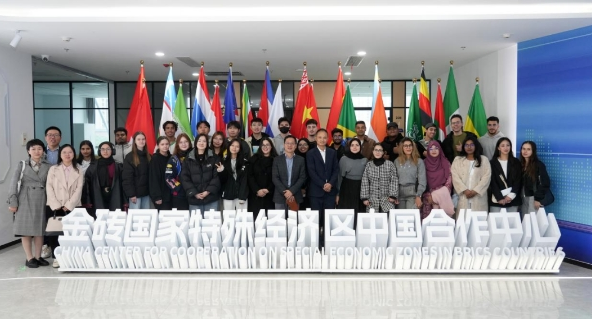
To deepen university-local cooperation and build a high-level platform for cross-cultural communication and practice for international students of our university, on the afternoon of October 22, Dean Wang Yi’an, Vice Dean Fei Chenhan of the School, together with international student representatives, were invited to conduct research and exchange at the Qiantang International Research Center and the China Cooperation Center of the Special Economic Zones of BRICS Countries. This visit helped international students understand the policy advantages of Qiantang, gain insights into the opportunities brought by BRICS cooperation, and launched an extraordinary practical tour to explore China’s opening-up and development.
Event Schedule
Jianghai City Exhibition Hall
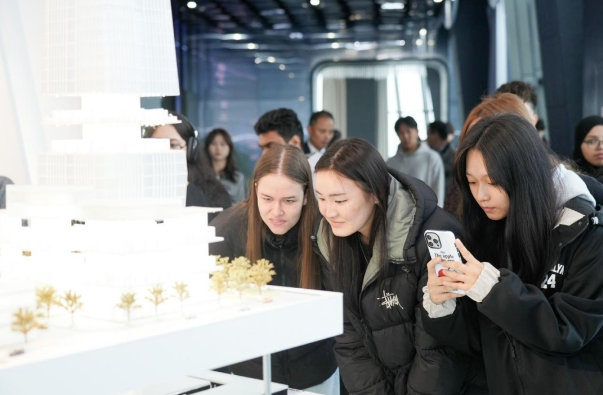
The first stop of the event was the Jianghai City Exhibition Hall. Guided by the staff, the international students embarked on a journey to explore urban development.
Inside the exhibition hall, the strategic positioning and development plans of Qiantang District as a demonstration zone for industry-city integration in the Yangtze River Delta were fully displayed through detailed graphic materials, advanced sand table models and multimedia presentations.
The international students gained an immersive understanding of the overall planning blueprint, spatial layout, industrial positioning and future development vision of Jianghai City. They also developed a more intuitive and in-depth perception of its ambitious plans and deeply felt the strong potential of the integrated industry-city development in Qiantang District.
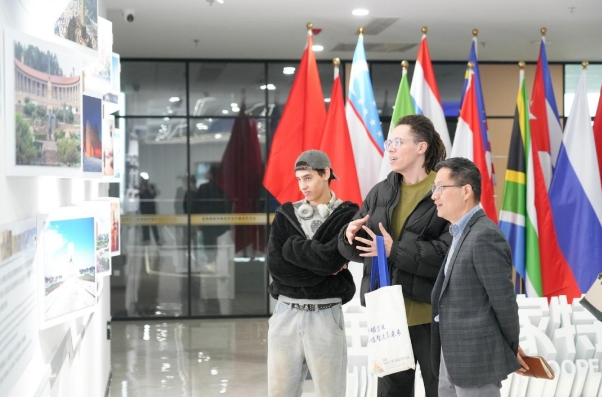
Later, the teachers and students from the School of International Education moved to the International Hall of the China Cooperation Center of the Special Economic Zones of BRICS Countries.
Under the professional explanation of the staff, the international students systematically learned about the cooperation achievements of BRICS countries in fields such as economic and trade connectivity, people-to-people and cultural exchanges, and scientific and technological collaboration.
From detailed data charts to vivid project cases, the depth and breadth of BRICS cooperation were intuitively demonstrated.
During the visit, the international students not only truly understood the core concepts of "openness and inclusiveness, innovation and coordination, and win-win cooperation" advocated by the BRICS cooperation mechanism, but also through the scenario-based displays in the exhibition hall, experienced in an immersive way the active practices and future development potential of Qiantang District, as a forefront of opening-up and cooperation, in promoting economic and trade exchanges and people-to-people interactions among BRICS countries.
International Hall of the China Cooperation Center for BRICS Special Economic Zones
Later, the teachers and students from the School of International Education proceeded to the “International Hall of the China Cooperation Center for BRICS Special Economic ZonesInternational Hall of the China Cooperation Center for BRICS Special Economic Zones”.
Under the professional guidance of the staff, the international students gained a systematic understanding of the cooperation achievements of BRICS countries in areas including economic and trade connectivity, people-to-people exchanges, and scientific and technological collaboration.
From detailed data charts to vivid project cases, the depth and breadth of BRICS cooperation were vividly presented.
During the visit, the international students not only fully grasped the core concepts of "openness and inclusiveness, innovation and coordination, and win-win cooperation" advocated by the BRICS cooperation mechanism, but also experienced through immersive scenario-based displays the active practices and future development potential of Qiantang District, as a frontier of opening-up and cooperation, in promoting economic and trade exchanges as well as people-to-people interactions among BRICS countries.
Following the visit, the two sides held a discussion and exchange on topics including BRICS international cooperation, university-enterprise collaboration in global expansion, international talent cultivation, and international communication.
Co-construction and Exchange
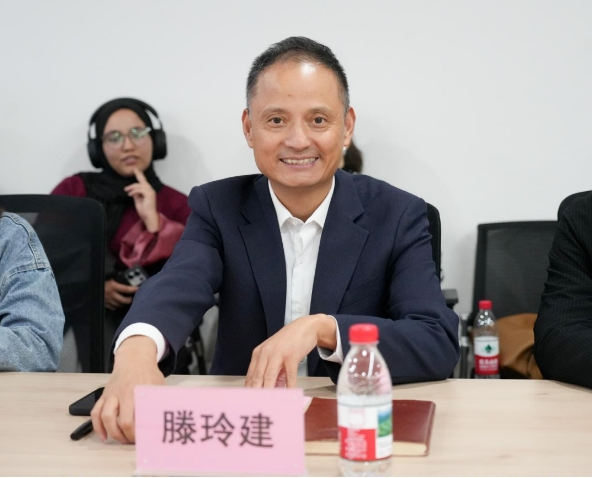
Teng Lingjian, Chairman of the Qiantang International Research Center, extended a warm welcome to the teachers and student representatives from the School of International Education of Hangzhou Dianzi University. He then briefly introduced the platform value of the Qiantang BRICS Cooperation Center and Jianghai City, as well as the service system of the Qiantang International Research Center.
He put forward cooperation directions with the School in joint brand building, collaborative research projects, and entrepreneurship incubation, and suggested deepening tripartite cooperation by establishing a communication mechanism. He expressed his expectation to continue working hand in hand with the School of International Education of HDU in the future, focusing on building a joint exchange and cooperation platform and developing branded education programs for international students, so as to jointly contribute to promoting international communication and boosting regional economic development.
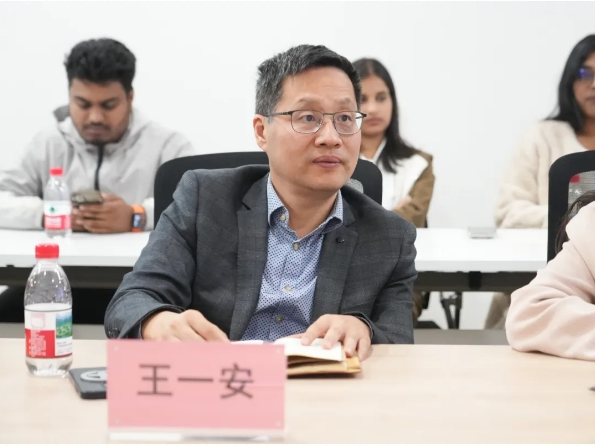
Wang Yi’an, Dean of the School of International Education, briefly introduced the student population, international development strategy and talent training outcomes of the School. He noted that the university has one of the largest international student populations in Qiantang District, with students from many countries. The School closely aligns with corporate needs to cultivate targeted talents, and has achieved remarkable results in talent supply and enterprise services, especially in Southeast Asia, Morocco and other regions, promoting the deep integration of international education with national strategies. He expressed the hope that through deepening cooperation with the research center, the School will further expand cooperation areas under the Belt and Road Initiative and BRICS cooperation, innovate international education models and cooperation approaches, and enable the university’s international education to develop in tandem with regional progress.
Fei Chenhan, Vice Dean of the School of International Education, thanked the research center for its warm reception and spoke highly of the strong potential of Qiantang District in the development of opening-up platforms and industrial growth. She proposed cooperation with enterprises to arrange innovative practice activities for students, and suggested matching academic programs with corporate needs — for example, launching research projects through university-enterprise cooperation and involving international students in research to support enterprises in their global development endeavors.
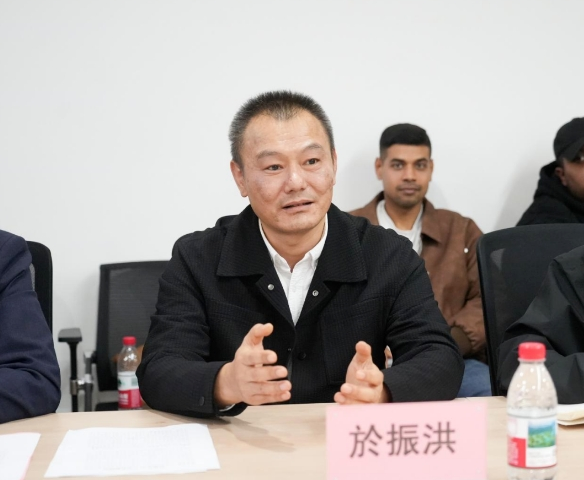
Yu Zhenhong, Member of the Party Leadership Group and Vice Chairman of the Federation of Social Sciences of Qiantang District, stated that Qiantang District has long been committed to promoting international research and practice, and welcomed teachers and students from Hangzhou Dianzi University for exchanges. He also expressed the hope that by showcasing the resources of Qiantang District, more high-end foreign research talents will be attracted to boost regional development, and looked forward to achieving more fruitful cooperation with the School of International Education of HDU in the future.
Insights and Reflections
During the discussion session, international student representatives spoke actively based on their visit experience and personal academic backgrounds, engaging in in-depth exchanges with the guests present, creating a lively and interactive atmosphere.
01
Yao Shimin
Yao Shimin from Kyrgyzstan said: “This visit and exchange left a very deep and pleasant impression on me. It is particularly worth mentioning that the Qiantang International Research Center carefully organized this tour, gave us a detailed introduction to its work, and listened earnestly to our opinions. Their open attitude and willingness to communicate made this visit especially meaningful and rewarding. I hope there will be more opportunities for mutual exchange and learning in the future.”
02
Xiao Shi
Xiao Shi from Bangladesh stated: “This visit was truly inspiring. Witnessing firsthand such a well-planned, technology-driven city and its blueprint for smart city development has been an unforgettable experience. I have gained a profound understanding of how modernization and innovation are shaping Hangzhou’s future, which has sparked a strong interest in such projects and even made me look forward to participating in them one day.”
03
Matthew
Matthew from Morocco said: “This activity has given us a profound insight into the development achievements and future strategic vision of Zhejiang Province, especially Hangzhou. We are delighted that the event was rich in content and highly enlightening. It has given us a clear understanding of the role played by China and the BRICS countries in promoting global cooperation, and further deepened our knowledge of China’s opening-up, innovative development, and cooperation with other nations.”
Through this visit to the **International Hall of the China Cooperation Center for BRICS Special Economic Zones**, the international students not only gained an in-depth understanding of Qiantang District’s development policies and opportunities under BRICS cooperation, but also witnessed firsthand China’s firm progress in promoting multilateral cooperation and common development.
In the future, the two sides will focus on BRICS cooperation and build more practical platforms for “going global and learning deeply”. This will help international students of our university strengthen friendship through exchanges and grow through practice, injecting youthful vitality into BRICS cooperation and global development.